Most designers don’t set out to copy anyone. They find a design they’re inspired by, save it for reference, and start working. But somewhere in the creative process, the finished piece ends up looking closer to that source than they ever planned.
This happens because original works are easy to study but difficult to set aside. Without a clear framework for using them, they can pull a design toward copying instead of originality.
This article walks you through how to spot the difference, understand why it happens, and use references without losing your own creative direction. The challenge, of course, is that the line between inspiration and imitation isn’t always obvious.
Inspiration vs. Imitation: Where the Line Actually Sits
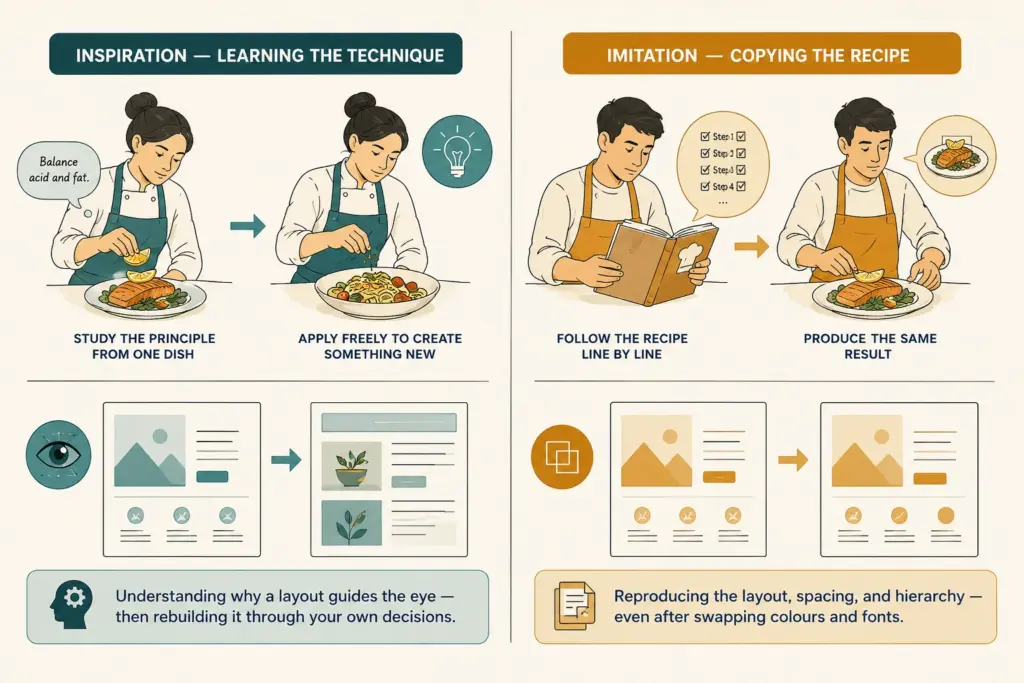
Inspiration and imitation look similar from the outside, but they work in opposite directions. Inspiration borrows a principle and rebuilds it through your own decisions. By contrast, imitation borrows the decisions themselves: the layout, the composition, and the visual choices someone else already made.
Think of it like cooking from a technique versus copying a recipe word for word. If you learn how a chef balances acid and fat, you can apply that logic to a completely different dish. But if you follow their exact recipe line by line, you’ve learned the recipe rather than the technique.
Design works the same way. Studying why a layout guides the eye is design inspiration. Reproducing that layout, spacing, and hierarchy is imitation, even if you swap the colours or fonts.
The difference is whether the reference informs your decisions or determines them, and creative people across every discipline have always understood that distinction.
Why Accidental Copying Happens in the Creative Process
Accidental copying happens because we don’t always remember where an idea came from as clearly as we’d like. Research from the University of Plymouth found that people were more likely to reproduce someone else’s idea after they had improved on it themselves. For designers, that process often begins with a reference.
The more closely you study a single design, the more its decisions become familiar. Instead of absorbing the principle behind the work, you start absorbing the work itself. Over time, it becomes harder to tell where the original designer’s choices end and your own begin.
Tight deadlines make this even more likely. When time is limited, it’s tempting to lean on structures that already work rather than explore alternatives. That’s when visual memory can have the strongest influence. An original work can guide your decisions long after you’ve closed the file.
How to Use References Without Copying Them
Fortunately, references aren’t the problem. How you use them is. A clear process separates drawing on other designers’ work from accidentally reproducing it.
The three steps below give you that framework.
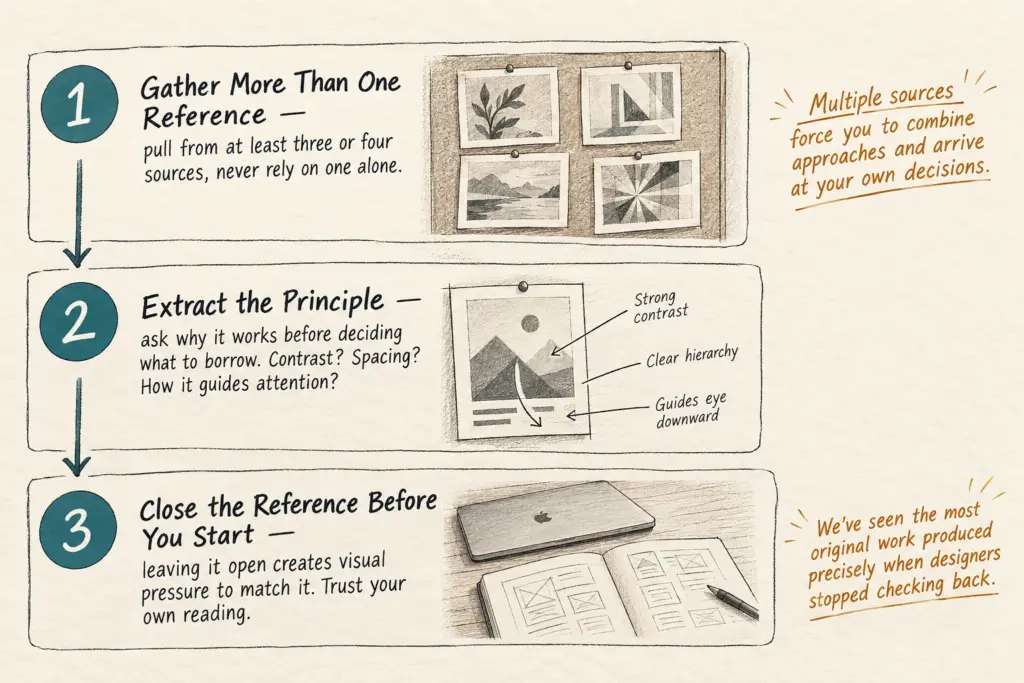
1. Gather More Than One Reference
Pull from at least three or four sources instead of relying on one source. A single design can easily become the blueprint for your work without you realising it. Using multiple references, however, creates distance by forcing you to combine different approaches and arrive at your own creative decisions.
2. Extract the Principles Behind the Design
Ask yourself why a reference works before deciding what to borrow from it. Maybe it’s the contrast, the spacing, or the way it guides attention toward a focal point. Identify that principle, then apply it through your own layout, content, and visual choices. The result is work that reflects your own thinking and creative decisions.
3. Close the Reference Before You Start Designing
Once you understand the principle, close the reference entirely. Leaving it open creates constant visual pressure to match what’s already there. We’ve seen students produce their most original work precisely when they trusted their own reading of a design rather than kept checking back against it.
Signs Your Design Might Be Too Close to the Source
Most designers don’t realise they’ve drifted until the work is almost finished. These are the signs worth checking before you get there.
- Identical Layout Structure: The grid, proportions, and visual hierarchy are the foundation every other decision sits on. If those mirror the original work closely, the resemblance will remain even after you’ve changed the colours, fonts, and imagery.
- Matching Colour Relationships: Individual colours are easy to swap, but the relationship between them is harder to change. The same balance between light and dark areas can preserve the resemblance, even after every individual shade has been replaced.
- Familiar Typographic Pairings: A matching font combination can create an immediate visual link to the source, even when the content is completely different. This one often catches people off guard since typography affects both the tone and personality of a design.
- Shared Compositional Framing: Compositional framing is the hardest sign to spot. When two designs lead the viewer’s eye through the same path, they can feel closely related even if the individual elements have changed.
A quick way to check how close your design is to the source: cover the reference and describe your output in words. If the description fits both pieces, the resemblance goes deeper than surface details.
What to Do If Your Work Looks Too Similar
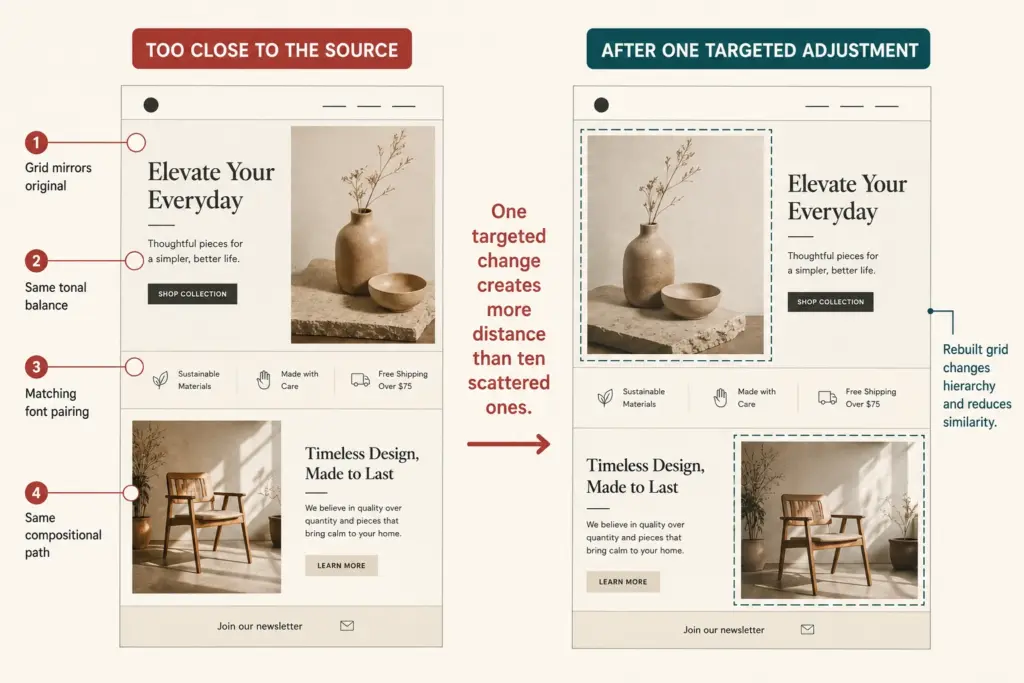
Start by pinpointing which specific element creates the resemblance. The culprit is usually the layout, the colour relationships, the typographic choices, or a combination of all three. It can be tempting to change everything at once, but that rarely helps. Doing so makes the project feel messy and leaves you stuck without a clear direction.
Instead, adjust the most distinctive element first. A layout that’s too close needs its grid broken and rebuilt around your own content hierarchy. For colour, move away from the source’s tonal balance rather than just swapping individual shades. One targeted change creates more distance than ten scattered ones.
If the resemblance persists, the compositional framing is likely the deeper issue. At that point, step away from the reference entirely and give yourself space to approach the design fresh.
Building Your Own Original Design Voice Over Time
Originality develops through how you work with references. Each project gives you another opportunity to build those instincts and recognise when an influence is helping your work rather than controlling it.
Over time, these habits stop feeling like rules and start becoming instinct. That’s when inspiration becomes a genuine creative resource rather than a risk.
At Class Room Encounters, we teach designers to build these foundations from the ground up. Visit our homepage to learn more about our approach and how we support designers at every stage of their development.